
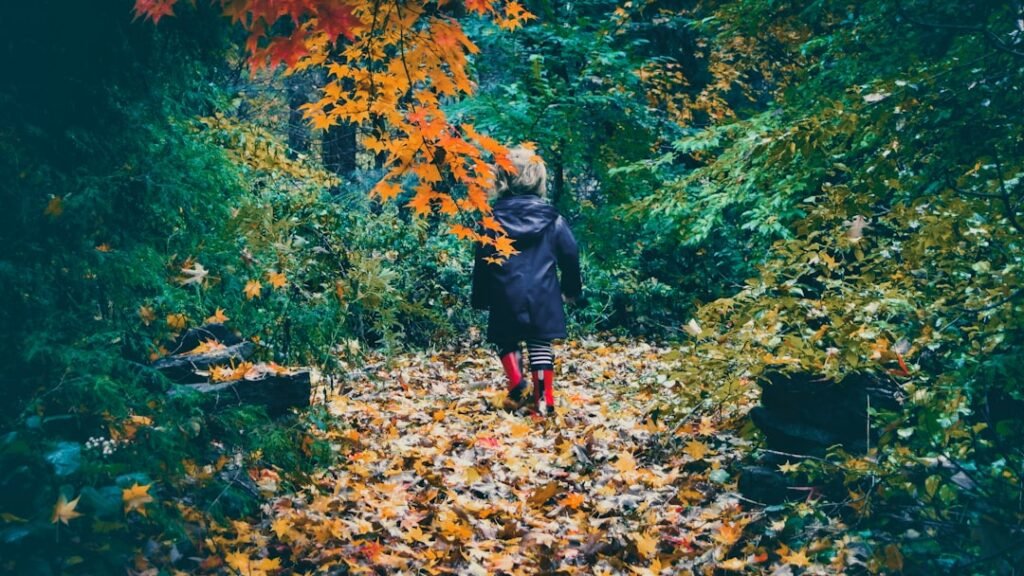
Last February, right in the thick of a Connecticut winter that felt like it would never end, I loaded all four boys into the van and drove us to a local state forest. No plan. No agenda. Just boots, layers, and a thermos of hot cocoa. My 10-year-old had been irritable for days. My 15-year-old was withdrawn in that quiet, hard-to-reach way that makes a mom’s heart ache. We’d been inside too long, and we all knew it — even if we couldn’t name it at the time.
We weren’t out there twenty minutes before something shifted. My 6-year-old started chasing squirrels through the snow. My 12-year-old found a frozen creek and spent thirty minutes poking at the ice with a stick, completely absorbed. And my 15-year-old? He walked beside me, and slowly — the way a window fogs up and then clears — he started talking. Really talking.
I don’t think that was a coincidence. And the more I’ve read, the more I’ve learned that it isn’t. There’s something genuinely powerful that happens when kids step outside, breathe fresh air, and let their nervous systems exhale. If you’re raising kids in Connecticut — where winters are long, screens are everywhere, and schedules get packed fast — this is worth paying attention to.
What the Research Actually Says About Kids and Nature
I’m a mom first, not a scientist, but I love knowing there’s real evidence behind what I observe in my own kids. The American Academy of Pediatrics has consistently highlighted the connection between time outdoors and improved mental health outcomes in children — including reduced anxiety, better attention, and lower rates of depression.
Studies on what researchers call “green time” — time spent in natural environments — show that it can lower cortisol levels (that’s your stress hormone), improve mood, and even help kids with attention challenges focus better afterward. One concept you might have heard of is “nature deficit disorder,” a term coined by author Richard Louv to describe the disconnection many modern children feel from the natural world — and the behavioral and emotional consequences that follow.
What struck me most when I started digging into this is how simple it can be. You don’t need a weekend wilderness adventure. You don’t need gear or a hiking checklist. Even short, regular time in nature — a walk through a neighborhood park, fifteen minutes in the backyard, a few minutes watching birds at a feeder — makes a measurable difference for kids’ emotional regulation and mental wellbeing.
Why Connecticut Is Actually a Gift for This
I know it doesn’t always feel that way in January, but honestly? We live in an incredibly nature-rich state. Connecticut has over 100 state parks and forests, miles of trails, rivers, shoreline, and four distinct seasons that — when we lean into them instead of resisting them — give our kids a really varied relationship with the outdoors.
We’ve hiked Sleeping Giant in the fall with the leaves turning gold. We’ve visited Hammonasset Beach State Park in the off-season when it’s nearly empty and the boys can run without restraint. We’ve walked through the Connecticut state forests in every season. Each one teaches them something different — about patience, about beauty, about the way things change and come back again.
As a family of faith, we find something sacred in that rhythm. The way the earth itself moves through seasons of bareness and abundance mirrors so much of what we talk about in Scripture. I don’t force that connection on the boys, but it comes up naturally, and they notice it. My 12-year-old once stopped on a trail and said, “It’s like God just reset everything.” That was after a particularly hard stretch for our family. He wasn’t wrong.
How Nature Helps Boys Specifically
Raising four boys means I’ve become something of a student of how boys in particular carry their emotional weight. They don’t always sit down and talk about how they’re feeling — and honestly, asking them directly can sometimes make things worse. But put them outside, give them something physical to do, and suddenly there’s space for the real stuff to surface.
Movement matters enormously for boys. Climbing, running, jumping, digging, throwing rocks into water — these aren’t just fun. They’re regulating. They help boys discharge the tension and energy that builds up when they’re sitting, learning, and navigating relationships all day. As a homeschool family, we have more flexibility than most to weave outdoor time into our daily rhythm, and I’ve seen firsthand how a mid-morning nature break can completely transform the emotional temperature of our school day.
My 6-year-old will have a meltdown over a math worksheet and then, after twenty minutes outside catching bugs or riding his bike, come back in a completely different child. My 15-year-old processes anxiety through long solo walks — something I’ve learned to support rather than question. The outdoors gives boys a place to be big, to be physical, to be free — and that freedom does something good for their inner world too.
Practical Ways to Build More Nature Time Into Your Family’s Life
You don’t have to overhaul your schedule to make this work. Here are the approaches that have actually stuck in our household:
- Make it a non-negotiable part of your school day. We take a “nature break” most mornings — even just 15 to 20 minutes of unstructured outdoor time. No phones, no agenda. The boys can do whatever they want outside. This simple habit has done more for our homeschool environment than almost any curriculum adjustment I’ve made.
- Let it be unstructured. Resist the urge to make outdoor time productive or educational every single time. Kids need the freedom to explore without a lesson attached to it. Unstructured outdoor play is where imagination, resilience, and emotional processing actually happen.
- Go out in all seasons. Connecticut winters tempt us all to hibernate, but outdoor time in cold weather is just as valuable — maybe more so, because the sensory experience is so different. Dress the kids well and go anyway. Some of our best family conversations have happened on cold, gray trail walks when there was nothing to distract us.
- Use local resources you already have. You don’t need to drive an hour to a state park every week. Your backyard, your neighborhood sidewalk, a local nature trail — these count. The consistency matters far more than the destination.
- Take your school outside when you can. Read aloud on a blanket. Do nature journaling. Study bugs, leaves, clouds, birds. Learning in outdoor environments is a legitimate educational approach with strong research behind it — and it breaks up the monotony of sitting at a table all day.
- Let older kids have solo outdoor time. My 15-year-old genuinely needs time outside alone to decompress. I’ve learned to honor that rather than always insisting on family togetherness. Giving him that space has actually made him more connected to the rest of us when we’re together.
Handling the Connecticut Winter Without Losing Your Mind
Let me be real with you: January and February are hard. The days are short, the boys are cooped up, and the emotional climate inside our house can get heavy. We’ve had winters where everyone was on edge by week three, and I had to get intentional fast.
A few things that have genuinely helped us get through the colder months without everybody going sideways emotionally:
- Commit to one outdoor family activity per week, rain or shine. Even a walk through a local park when it’s 28 degrees does something real for everyone’s mood. We make it an event — hot drinks, good boots, a destination in mind.
- Set up bird feeders near your windows. This sounds small, but watching birds throughout the day connects kids to nature even from inside. My 10-year-old became genuinely passionate about identifying Connecticut bird species this past winter because of a simple feeder hanging outside the kitchen window.
- Embrace the mud and the mess of early spring. March in Connecticut is not pretty. But it is alive, and kids who spend time outside in it come in energized and emotionally lighter. Mud boots are worth every penny.
If your kids are really struggling with winter mood or motivation, it’s worth noting that seasonal shifts can genuinely affect children’s mental health. Light exposure matters. Getting outside even on overcast winter days provides more natural light than sitting by a window, which can help regulate mood and sleep. If you’re noticing persistent sadness, withdrawal, or significant behavior changes in your kids through the winter months, it’s always worth a conversation with your pediatrician.
What This Does for Your Family Connection
One of the most surprising gifts of building more outdoor time into our family life has been what it does for us as a family. There’s something about being outside together that strips away the friction and pressure of the day-to-day. Nobody’s asking for snacks. Nobody’s negotiating screen time. We’re just moving through the same space, noticing the same things, sometimes talking and sometimes not.
Some of the most important conversations I’ve had with my boys — about God, about hard things they’re walking through, about who they’re becoming — have happened on walks or hikes. There’s a side-by-side quality to outdoor time that makes it easier for kids (especially boys) to open up. You’re not sitting across from each other making eye contact. You’re just walking. And somehow, that makes everything feel more accessible.
We also use outdoor time to reinforce something we talk about regularly in our home: the idea that rest and restoration are gifts, not rewards. That slowing down enough to notice the world around us is an act of gratitude. We’ve written about the value of intentional rest and slowing down together as a family — and getting outside is one of the most accessible ways we’ve found to actually live that out, not just talk about it.
Starting Small Is Still Starting
If your family isn’t in the habit of spending regular time outdoors, please don’t let the gap between where you are and where you want to be stop you from beginning. You don’t need a plan. You don’t need the right gear. You don’t need a destination.
Start with ten minutes after dinner. Start with letting the kids play in the yard while you sit on the porch with your coffee. Start with a Saturday morning walk around your neighborhood. Nature doesn’t require a performance. It just requires you to show up.
I’ve watched it work in my own family over and over — not as a cure-all, but as a consistent, quiet, steady foundation for healthier, happier kids. The February hike I mentioned at the beginning of this post? My 15-year-old talked to me for almost two hours that day. About things he’d been holding for weeks. About fears and questions and hopes. I didn’t orchestrate that. The woods did the heavy lifting. I just showed up.
That’s enough. Showing up is enough. Get outside, Connecticut families. Something good is waiting for you there.

Pingback: Raising Boys Who Are Emotionally Healthy
Pingback: Family Fitness Habits That Actually Last | CT Mom Guide