
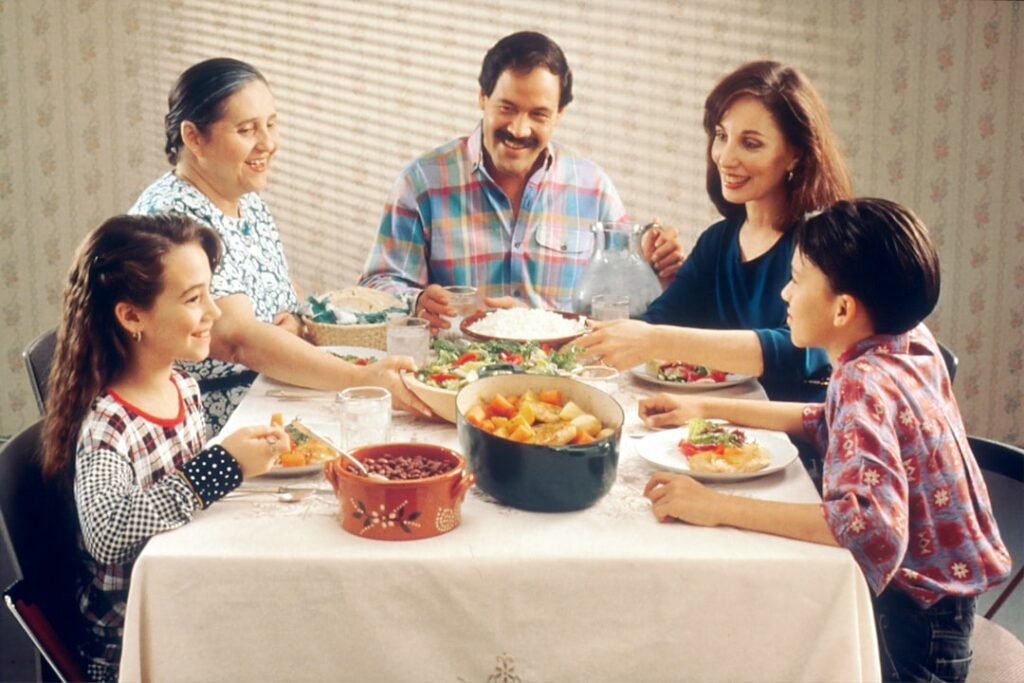
It started with a Tuesday night that almost broke me. My 15-year-old was deep in a mood I couldn’t crack, my 12-year-old had a meltdown over a math lesson that had gone sideways, my 10-year-old was still buzzing from three hours outside, and my 6-year-old had decided that dinner was the perfect time to announce he would never — not ever — eat soup again. I stood at the stove stirring a pot of chicken and vegetable soup that had taken me forty-five minutes to make, and I thought: Why do I even try?
But then something shifted. My husband pulled up a chair and started asking the boys about the dumbest thing that happened to them that day. Within five minutes, even my 15-year-old was laughing. My 6-year-old ate two bowls of the soup he swore he hated. And by the time we cleared the plates, something in the air felt lighter. That meal didn’t fix anything. But it connected us. And honestly? That’s exactly what it was supposed to do.
If you’ve been feeling like your family is running on empty — stretched thin between homeschool lessons, activities, errands, and all the noise that comes with raising kids — I want to invite you back to the dinner table. Not in a guilt-trip kind of way, but in the way a friend would say: this one thing is worth protecting. The research backs it up, but more than that, my own life has proven it over and over again.
Why Family Meals Are About So Much More Than Food
We tend to think about mealtimes in terms of nutrition — are the kids eating their vegetables, are we limiting processed food, is everyone getting enough protein? And yes, those things matter. But the research on family meals consistently shows that the relational benefits are just as significant as the nutritional ones.
The American Academy of Pediatrics and numerous child development studies have found that children who eat regular family meals together show lower rates of anxiety and depression, stronger academic performance, better communication skills, and are less likely to engage in risky behaviors as teenagers. That’s a lot of return on investment for one meal a day.
But here’s what I’ve noticed in our own home: it’s not just about what’s on the table. It’s about what happens around it. The conversations. The inside jokes. The moments where my 10-year-old says something surprisingly wise and we all stop to really look at him. The nightly ritual of it — the sameness — gives my boys something to count on, especially on the days when everything else feels unpredictable.
What “Regular” Family Meals Actually Looks Like in a Real Home
Let me be honest with you: we do not eat together every single night. We aim for it, but life is life. There are evenings when my husband is working late, or we have a commitment that scatters us. I used to feel guilty about the nights we missed. Now I’ve made peace with the fact that consistency doesn’t mean perfection — it means intention.
For us, a “regular” family meal looks like sitting down together four to five evenings a week. We also try to make Saturday breakfast a big deal — eggs, toast, fruit, everyone in the kitchen together, no rush. My 6-year-old has decided he’s the official “juice pourer” and takes his job very seriously. That Saturday morning table has become one of my favorite places in the world.
If dinners together feel completely impossible right now, start with breakfast. Or lunch, since we’re homeschooling anyway. The meal doesn’t have to be elaborate. What matters is that you’re present, unhurried, and genuinely engaged with the people sitting across from you.
How to Make the Dinner Table a Place Kids Actually Want to Be
Here’s a truth I learned the hard way: kids don’t magically love family meals just because we show up. Especially boys. Especially teenagers. You have to create an atmosphere that feels safe, fun, and worth their time. That takes a little bit of thought, but it doesn’t take a lot of effort once it becomes habit.
A few things that have genuinely worked in our home:
- No phones at the table — ever. This is non-negotiable for us, and it applies to my husband and me too. The rule isn’t about punishment; it’s about presence. When everyone’s eyes are up, conversation actually happens.
- Use a conversation starter routine. We’ve done “Rose and Thorn” (one good thing, one hard thing about your day) for years. My kids roll their eyes at it sometimes, but they always participate, and we’ve heard some really important things through that simple question.
- Let kids have ownership of something. My 12-year-old picks the dinner music on Wednesdays. My 10-year-old helps me choose the side dish on Fridays. My 6-year-old sets the napkins — his way. Giving kids a role at the table makes them feel like they belong there.
- Keep the atmosphere light more often than heavy. We do have serious conversations over dinner sometimes. But most nights, we’re laughing more than anything. Save the big talks for when they naturally arise, not every single meal.
- Occasionally make it special for no reason. Candles on a random Tuesday. Letting everyone pick their own cup. Calling it “fancy dinner” when it’s literally just pasta. Small things mean more to kids than we realize.
Food as an Act of Love — And a Faith Practice
One thing I’ve come to believe deeply is that feeding my family is an act of love and, in a quiet way, an act of faith. There’s something in the rhythm of preparing food for the people you love that feels like a form of service — of showing up and saying, you matter to me, and I want to nourish you.
In our home, we pray before we eat. We’ve done it since our boys were tiny, and by now it’s as natural as sitting down. My 6-year-old has started adding his own prayers at the end — sometimes they’re two sentences, sometimes they take a full minute because he has strong opinions about what God should know. Those prayers slow us down. They remind us, before we even take a bite, that this meal is a gift and so is this family.
I’m not saying you have to do it exactly the way we do. But if you’re looking for a gentle, consistent way to bring faith into your daily rhythm without making it feel like a production, the dinner table is one of the most natural places to start.
The Nutrition Side — Because It Really Does Matter
I’d be doing you a disservice if I skipped this entirely. The food we put on the table does matter, and raising four active boys has taught me a lot about what fuels them well and what doesn’t.
A few practical things I’ve landed on after years of trial, error, and one very picky 10-year-old:
- Protein at every meal keeps the peace. Hangry boys are a real phenomenon. Eggs, chicken, beans, cheese — whatever works. Getting enough protein keeps moods steadier and energy more consistent, especially during our homeschool mornings.
- Involve kids in meal prep to improve their willingness to eat. My 12-year-old is far more likely to eat a salad he helped make. My 15-year-old has been learning to cook simple dinners on his own one night a week — it’s become one of the best things we’ve introduced this year.
- Don’t fight about food at the table. I made a rule early on: I will always provide something at dinner that each child can eat. But I will not make a separate meal. If my 6-year-old doesn’t love the main dish, there’s always bread and fruit. Taking the battle out of mealtime has made our table so much more peaceful.
- Connecticut has incredible seasonal produce — use it. From summer corn and tomatoes to fall squash and apples from our local farm stands, eating seasonally has made our meals feel more connected to where we live. If you haven’t explored any of Connecticut’s pick-your-own farms or farmers markets, that’s a whole activity worth building into your family rhythm too.
For solid, practical nutrition guidance for kids, I’ve always appreciated the resources available through the USDA’s MyPlate, which breaks down age-appropriate food guidance in a really accessible way.
When Mealtimes Feel Like a Battlefield
Some seasons are harder than others. When we hit a rough stretch with one of my boys — a difficult phase, high stress, or a period of emotional distance — the dinner table can feel tense instead of warm. I’ve been there. Some nights the meal itself becomes the backdrop for whatever conflict is simmering beneath the surface.
In those seasons, I’ve learned to lower my expectations for what the meal needs to accomplish. Sometimes just being in the same room together, sharing the same food, is enough. You don’t have to manufacture connection. Sometimes you just have to keep showing up and trust that the routine itself is doing more than it looks like it’s doing.
If you’re working through bigger emotional challenges with one of your kids right now — anxiety, withdrawal, or just that hard-to-name distance — being intentional about raising emotionally resilient boys is something I’ve written about from the heart, and it might give you some language for what you’re navigating.
Making It Work for Homeschool Families Specifically
One of the gifts of homeschooling — and there are many, even on the hard days — is that we have access to more shared meals than most families do. We eat breakfast together before lessons, we break for lunch together in the middle of the day, and we sit down for dinner most evenings. That’s a lot of togetherness, which can be both a blessing and a challenge.
What I’ve found is that making mealtime distinct from school time matters a lot in a homeschool house. Lunch isn’t a lesson extension. It’s a break, a reset, a chance to laugh and breathe before the afternoon. Protecting that boundary has made our whole day feel more sustainable.
Mealtimes also give us a natural check-in rhythm. I can often tell by how a child is engaging at the lunch table whether the morning went well or whether someone needs a gentler afternoon. You don’t always need a formal sit-down conversation to read your kids — sometimes the table tells you everything.
For those days when the whole rhythm of your home needs a reset — not just mealtime but everything — I’ve shared some of our family’s go-to strategies in this post about creating a family reset day that might be worth revisiting.
One Small Step to Start
If family meals feel overwhelming right now — maybe you’re in a season of survival, or your schedules are genuinely chaotic — I want to offer you the smallest possible starting point: pick one meal this week and protect it. Just one. Turn off the screens, sit down together, and ask each person one question. That’s it. You don’t need matching plates or a beautiful spread. You just need to show up.
The table has a way of doing the rest.
I genuinely believe that some of the most important work we do as parents happens not during the grand moments, but in the daily, unremarkable, nourishing act of feeding our people and sitting with them. It’s not glamorous. Some nights it’s loud and chaotic and someone spills their milk. But it is good. It is deeply, quietly good.
And on those nights when everything clicks — when the soup is warm, the conversation is easy, and your whole loud, wonderful family is gathered around the table — you’ll know exactly what I mean.
