
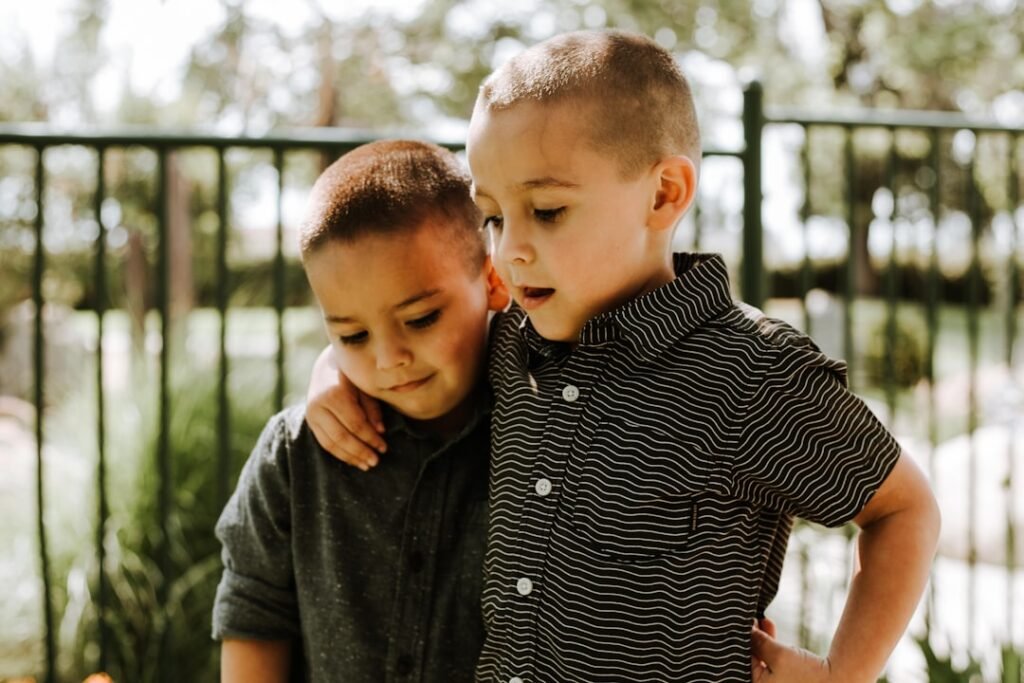
My 10-year-old rolled his eyes at me last spring. Not a subtle eye-roll, either — a full, theatrical, slow-motion roll that I’m pretty sure could be seen from the driveway. And my first instinct, if I’m honest, was to snap back with something sharp. Instead, I took a breath and said, “That tells me you’re frustrated. Try again.” He blinked. He tried again. And the moment passed without a blowup.
But it got me thinking. Real respect — the kind that sticks — doesn’t come from threatening consequences every time a kid forgets his manners. It comes from something much deeper. And if you’re raising boys, especially multiple boys at wildly different ages, you probably already know that you can drill “yes ma’am” into their heads all day long without ever actually building the character underneath it.
I want to talk about what it actually looks like to raise boys who respect others genuinely — their parents, their siblings, strangers, teachers, and one day, their future wives and coworkers and neighbors. Not because they’re afraid of getting in trouble, but because they actually understand why it matters.
Respect Isn’t a Rule — It’s a Value You Have to Model First
This one stings a little, but it’s worth sitting with. Boys are watching everything. My 15-year-old notices how I talk to the cashier at the grocery store. My 6-year-old watches how his dad and I speak to each other during stressful moments. Long before they can articulate it, kids are building an internal picture of what respect looks like in action.
If you want your boys to speak kindly to people who are “below” them in some perceived hierarchy — younger kids, service workers, people who are different from them — they need to see you do that first. Every single day. That doesn’t mean you have to be perfect. It means that when you fall short, you show them what accountability looks like too. “I was rude to Dad this morning when I was stressed. That wasn’t okay. I apologized.” That moment teaches more than a hundred lectures.
In our home, we come back to a simple truth we’ve drawn from scripture: treat others the way you want to be treated. It’s not complicated. But living it out in the small, ordinary moments of Tuesday afternoons is where the real work happens.
Name What Disrespect Actually Looks Like — Specifically
Here’s something I’ve learned: boys often don’t know they’re being disrespectful. Truly. My 12-year-old once interrupted me eleven times in one conversation without realizing he’d done it even once. When I pointed it out calmly afterward, he was genuinely surprised. He wasn’t trying to be rude — he just hadn’t been taught to notice it.
So we started naming things clearly, without shame and without lectures. Things like:
- Interrupting when someone is speaking — and why it communicates that your words matter more than theirs
- Dismissive body language — eye-rolling, walking away, sighing loudly mid-conversation
- Talking over someone — especially a sibling or someone younger
- Ignoring a greeting — when someone says hello and gets nothing back
- Tone of voice — because “fine” can be respectful or deeply disrespectful depending on how it’s said
When you name these things out loud — calmly, as a family — boys start to notice them. They start catching themselves. And that internal awareness is worth far more than obedience that only exists because you’re standing in the room.
Make Your Home a Place Where Everyone’s Voice Gets Heard
One of the most powerful things we do in our home is make sure every boy gets heard — even when what they’re saying is inconvenient or when they’re disagreeing with us. My husband and I have learned to pause and listen, really listen, even when a protest seems irrational. Because when boys feel heard at home, they learn that listening to others is a valuable, meaningful act — not just a social obligation.
We started doing something a couple of years ago that sounds small but has made a real difference: we have a loose family rule that if someone is talking, devices go down and eyes come up. Not phones-in-pocket — completely down, face-to-face. We don’t enforce this with punishment. We just model it consistently, and the boys have genuinely picked it up. Even my 15-year-old, who I was sure would resist this the most, now naturally sets his phone on the counter when we start a conversation.
The American Academy of Pediatrics has noted the importance of face-to-face interaction for children’s social development — and honestly, that research just confirms what we’ve seen lived out at our own kitchen table. Connection happens when we look at each other.
Use Real Situations — Not Hypotheticals — to Teach Respect
I’m a big believer that the best character training happens inside real moments, not role-play scenarios in the living room. When something happens — my boys argue, one of them says something unkind to a sibling, or we witness disrespect somewhere in public — that’s when we talk about it. Not in the heat of the moment, but soon after, when everyone is calm.
The question I come back to is: “How do you think that made them feel?” It sounds so simple, but it’s actually asking boys to do something hard — to step outside themselves and imagine another person’s inner experience. Empathy is the engine of genuine respect, and it takes practice to build.
One afternoon last fall, my 10-year-old said something dismissive to his younger brother when the 6-year-old was trying to show him something he’d built with blocks. My 6-year-old’s face fell. I didn’t correct my 10-year-old in the moment — I let it pass. But that evening I brought it up quietly, just the two of us, and I asked him what he noticed about his brother’s face after he said that. He remembered. He didn’t like that he’d caused it. That’s the seed of real change.
Teach Them That Respect Includes People Who Are Different From Them
Raising boys in Connecticut means raising them in a place with real diversity — different backgrounds, different beliefs, different family structures, different experiences. I want my boys to be kind and respectful toward everyone, not just people who look and live like them.
This doesn’t mean we don’t have our own convictions — we do, and our faith shapes them deeply. But holding firm beliefs and treating everyone with dignity are not in conflict. In fact, we believe they should go hand in hand. My boys hear us talk regularly about the inherent worth of every person. We talk about this when it comes up naturally — when we read history, when we see something in the news, when we encounter it in our community.
The goal isn’t that they agree with everyone or never have opinions. The goal is that they know how to disagree with dignity and extend basic human kindness regardless of differences. That’s a skill that will serve them their whole lives.
Give Them Language for Hard Moments
One thing that’s helped our boys enormously is giving them actual words to use when they’re frustrated, angry, or feeling disrespected themselves. Because let’s be honest — disrespect often comes out of boys who don’t know what to do with their big feelings in the moment.
We’ve practiced phrases like:
- “I need a minute” — instead of blowing up or shutting down
- “That hurt my feelings” — said calmly, as a statement, not an accusation
- “I don’t agree, but I’m listening” — for disagreements with us or with each other
- “Can we talk about this later when I’m calmer?” — something even my 12-year-old has started using, and it genuinely amazes me every time
When boys have language, they have options. And when they have options, they’re less likely to default to the kind of reactive behavior that looks a lot like disrespect even when it’s really just overwhelm.
If you’ve been working through this alongside helping your boys handle big emotions, you might find it helpful to read how to help your boys develop a healthy relationship with their own emotions — because these two things are deeply connected.
Let Natural Consequences Do Some of the Teaching
I used to jump in quickly to smooth things over when my boys were rude to someone and the other person reacted coolly toward them afterward. But I’ve learned to step back and let that awkward silence or that hurt expression do its own work. Natural consequences are powerful teachers.
When my 15-year-old was dismissive toward a friend during a group hangout last year, the friend pulled back and things felt strained. He noticed. He came home quiet. That evening he said, “I think I was kind of a jerk today.” I didn’t pile on — I just said, “What do you think you could do about it?” He texted an apology that night. That’s growth I couldn’t have manufactured.
We step in when a situation requires it — when something is hurtful or when a boy genuinely doesn’t understand what happened. But natural relational consequences, allowed to play out, often teach lessons that parental lectures simply can’t.
Affirm Respect When You See It — Out Loud
I want to end with this because I think we forget it in the exhaustion of daily parenting: when your boys get it right, say so. Specifically. Not just “good job” but “I noticed the way you waited for Grandma to finish talking before you responded — that was really respectful, and I’m proud of you.”
Boys — all kids, really — lean into who we tell them they’re becoming. When we name the good we see in them, we’re helping them build an identity around it. “I’m a respectful person” is a powerful thing for a boy to believe about himself. And the more he believes it, the more he’ll work to live up to it.
According to research highlighted by the CDC’s positive parenting resources, positive reinforcement and warm parent-child relationships are among the most effective tools for shaping children’s behavior and character over the long term. What we know from faith and what research tells us keep pointing in the same direction: relationship is the foundation.
Raising respectful boys is slow work. It’s not a curriculum you can finish, and it’s not a problem you can solve with the right punishment system. It’s a thousand small moments strung together over years — moments where you model it, teach it, name it, affirm it, and trust God with the rest. You’re doing more than you know, mama. Keep going.

Pingback: Raising Boys Who Serve Others | CT Mom's Guide