
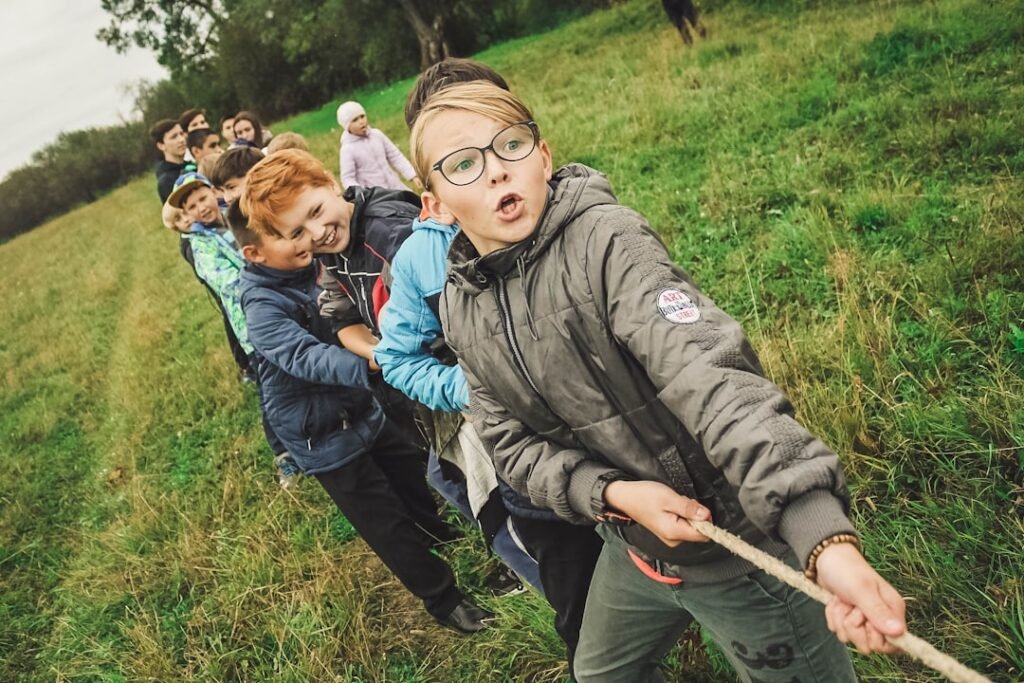
My 15-year-old walked into the kitchen last fall looking genuinely frustrated. He’d been put in charge of a group project at our homeschool co-op, and instead of the team pulling together, it had fallen apart. Kids weren’t doing their parts. He’d gotten annoyed. Things got tense. He came home deflated and said, “I don’t think I’m a good leader.”
I poured him a glass of water, sat down across from him, and told him the truth: that moment right there — that frustration, that honest self-reflection — was actually one of the most important parts of becoming a good leader. Not the falling apart. The sitting with it afterward.
Leadership is one of those words that gets thrown around a lot in parenting circles, but I’ve found that most of the conversations around it are focused on the wrong things. We talk about confidence, assertiveness, being “the one in charge.” But real leadership — the kind that actually matters, the kind I want my boys to carry into their adult lives — looks a lot more like humility, responsibility, and the ability to bring out the best in the people around them.
And it starts way earlier than most of us think.
Why Leadership Development Starts at Home
Before any of my boys ever led a team, a class, or a group of friends, they practiced leadership every single day inside these four walls. The way my 12-year-old steps up when his younger brother is having a meltdown. The way my 10-year-old takes ownership when he breaks something instead of blaming his brother. The small, quiet moments where a boy chooses the harder right thing over the easier wrong one — those are the building blocks.
The American Academy of Pediatrics has long emphasized that character development in children is deeply shaped by the environments they grow up in — particularly the family. How we respond to conflict, model accountability, and talk about responsibility sends powerful messages every day, even when we think nobody’s watching.
The home is where leadership is first learned. And that’s actually good news for us as parents, because it means we have more influence than we sometimes feel like we do.
The Difference Between a Leader and a Boss
This is a conversation I’ve had with my boys more than once. Because there’s a real difference, and it matters.
A boss tells people what to do. A leader influences people toward something worth doing. A boss focuses on control. A leader focuses on direction and care. A boss gets frustrated when things don’t go their way. A leader learns how to adapt without losing sight of the goal.
When my oldest was struggling with that co-op project, we spent a long time talking about this. He had been managing the group — assigning tasks, setting expectations, keeping track of deadlines. But he hadn’t been leading them. He hadn’t asked what each person was good at. He hadn’t checked in to see if anyone was stuck. He’d focused on the outcome without paying attention to the people.
That’s not a character flaw. That’s a skill gap. And skill gaps are exactly what parents are here to help close.
Age-Appropriate Ways to Build Leadership at Home
One thing I’ve learned across four boys is that leadership development doesn’t look the same at every age. What works for a 15-year-old looks very different from what works for a 6-year-old. But the seeds can be planted at any age, and they grow slowly and steadily if we’re intentional about it.
For your youngest (ages 5-7): Focus on responsibility and follow-through. Simple tasks that belong to them — feeding a pet, setting the table, putting away their own laundry — teach ownership. When your 6-year-old does his job without being reminded, pause and name it. “You did that without me asking. That’s what responsible people do, and responsible people make great leaders someday.”
For the middle years (ages 8-11): Start introducing the idea of serving others. Can your 10-year-old help his younger brother with something hard? Can he lead a small family project — planning a Saturday hike, organizing the book bins in your homeschool room? Give him real responsibilities with real stakes, not just token tasks. Let him problem-solve when things go sideways instead of jumping in to fix everything.
For the preteen and teen years (ages 12-15): This is where leadership development gets real. Your older boys are ready for conversations about influence, integrity, and what kind of person they want to be known as. They can take on genuine mentorship roles with younger siblings. They can lead in your church community, your homeschool co-op, or your neighborhood. And crucially, they need to be allowed to fail — and then coached through how to get back up.
Teaching Boys That Leadership Requires Listening
If I had to pick the single most underdeveloped leadership skill in boys — and honestly, in most people — it would be listening. Not waiting for your turn to talk. Not formulating your response while the other person is still speaking. Actually listening.
We practice this at our dinner table. We have a loose rule that if you want to share something, you also have to ask someone else a question about their day first. It sounds small, but it rewires something. It teaches my boys that the world does not actually revolve around their own thoughts and experiences, and that being curious about other people is a form of strength, not weakness.
I also make it a point to model this myself — to let my boys see me say, “Wait, tell me more about that,” instead of jumping to solutions. When they see me practicing curiosity, it normalizes it for them.
The Role of Faith in Raising Servant Leaders
In our home, our understanding of leadership is deeply shaped by our faith. We talk a lot about servant leadership — the idea that the greatest leaders are the ones who show up to serve, not to be served. That the leader who kneels down to help someone is worth more than the one who stands at the front of the room looking impressive.
This doesn’t take a lecture. It takes repetition over years. It takes pointing it out when we see it — in church, in the community, in stories we read together. My boys have heard me say more than once that the men I most respect in this world are the ones who lead quietly, who are more concerned with doing right than being recognized for it, and who lift others up without keeping score.
That kind of leadership is countercultural. And raising boys who embody it is some of the most important work we can do.
Let Them Lead in Real Ways — and Let Them Fail
One of my biggest parenting mistakes in the early years was over-managing. I’d give my boys a responsibility, then hover. I’d let them “be in charge” of something, but then step in the moment it got hard. What I was actually teaching them was that they weren’t capable, and that leadership was something you performed when an adult was watching.
Real leadership development requires real stakes. Not dangerous ones — but genuine ones. Let your 12-year-old plan and execute a family game night from start to finish. Let your 15-year-old lead a devotional for your family one evening per week. Let your 10-year-old be genuinely responsible for the morning routine of your younger kids on certain days. And then step back.
When it goes sideways — and it will — resist the urge to rescue. Ask questions instead. “What happened? What would you do differently? What do you think you need to try next?” That debrief is where the real learning happens.
If you’ve been working on helping your boys handle mistakes and setbacks well, you might find this post helpful too: how to help your boys develop a healthy relationship with failure. Building leadership and learning to handle failure are deeply connected skills.
Homeschooling Creates Unique Leadership Opportunities
I’ll be honest — this is one of the parts of homeschooling I didn’t fully appreciate until we were a few years in. When you’re homeschooling multiple ages, older kids naturally have opportunities to explain concepts to younger ones, to model patience, to step into a mentorship role in a way that just doesn’t happen in a traditional classroom setting.
My 12-year-old has become a genuinely excellent explainer. He has this patient, thoughtful way of breaking down math concepts for his 6-year-old brother, and watching it happen is one of my favorite parts of our school week. He doesn’t even realize what he’s building in himself — the ability to understand something deeply enough to teach it, the patience to meet someone where they are, the quiet confidence that comes from being genuinely helpful.
If you’re navigating the social side of homeschooling in Connecticut and looking for community spaces where your boys can practice leadership with peers, this post on building real friendships as a homeschool family has some practical ideas for finding those spaces right here in our state.
Watch How You Talk About Leaders in Front of Your Boys
This one stings a little, because it requires some honest self-examination. Our boys are absorbing everything — including how we talk about the leaders and authority figures in their lives. Teachers, coaches, pastors, political figures, community leaders. When we tear people down casually, when we model cynicism or disrespect toward people in leadership, we are quietly teaching our boys that leadership is something to be mocked or doubted, not aspired to.
That doesn’t mean we don’t talk honestly about when leaders make poor choices or fail in their responsibilities. We absolutely do. But there’s a difference between thoughtful, honest conversation and reflexive criticism. I want my boys to grow up with a deep respect for the responsibility that comes with leadership — and that means I have to model that respect myself, even when it’s hard.
The Long Game of Leadership
Here’s what I remind myself on the hard days, when my boys are arguing over who’s in charge of what, or when my 15-year-old comes home deflated after another leadership stumble: this is a long game. I am not trying to produce a polished leader by next Tuesday. I am planting seeds that will grow over years and decades.
The CDC’s resources on child development remind us that the social and emotional skills children build throughout childhood are cumulative — each stage builds on the last. There are no shortcuts, but there’s also no wasted effort. Every conversation, every moment of coaching, every time we let our boys lead and then help them reflect — it all counts.
My boys don’t need to be the loudest, the most impressive, or the first to raise their hands. I want them to be the ones who show up consistently, who treat people with dignity, who do the right thing when no one is watching, and who know how to bring out the best in the people around them. That’s the kind of leadership that changes families, communities, and — if I dare to dream big — the world.
And it starts in your kitchen, at your dinner table, in the quiet ordinary moments you might not even realize are shaping them. Keep going. It’s worth every bit of the effort.
